Noted To Death
Follow no rules. Give no comfort.
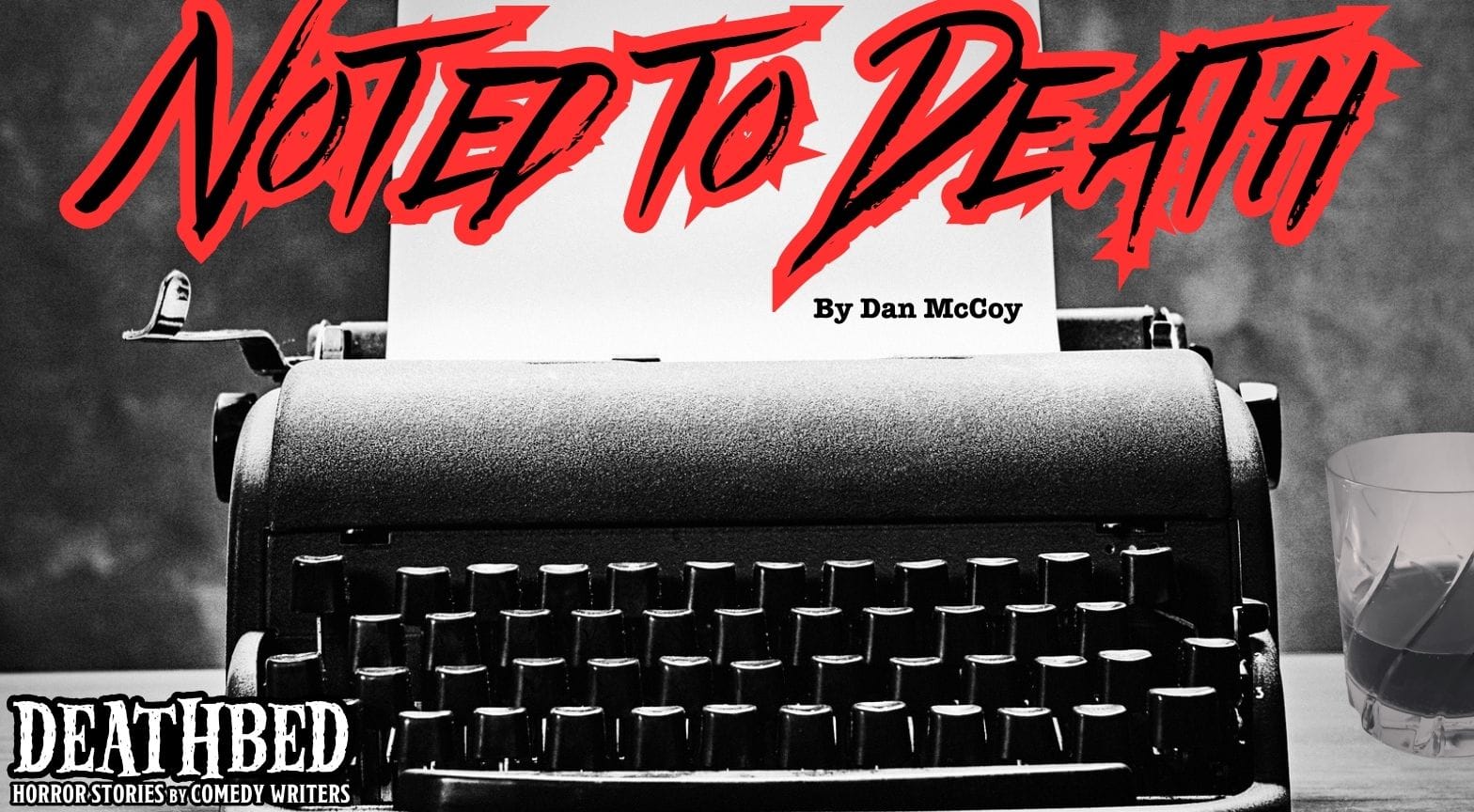

Lawson sat back from the typewriter and glanced at his watch. Nearly midnight. He cursed, quietly, then louder — the bullpen was empty, so why the hell not? Whose sensibilities was he protecting? He pulled the page from the roller, blew on it, then tossed it in his out basket, beneath a tasteful pen-and-ink drawing of a worm crawling from a zombie’s nostril that some wag had pinned to the wall with the caption “our fearless leader.”
It was Humphrey’s fault he was still here. College boy. The publisher had wanted to give the kid a shot — over Lawson’s objections. After all, Lawson was merely editor-in-chief. What did he know?
Still, even if he hadn’t exactly taken the job by storm, at least the kid would be leaving Linda as a parting gift. Linda with the too-short skirt and the too-low neckline. Linda whose eyes always seemed to dare you to try something, and whose lips curled into a smile when you did. The little punk had been so proud to show her off at the Christmas party. He should’ve known not to flash a valuable possession like that around thieves.
After the way he’d had to ashcan the kid, he almost felt bad about taking Linda. But Larson consoled himself with the knowledge that someone like Humphrey could never keep a woman like that, no matter how many ten cent words he tossed at her.
“All that learning, but no talent,” Lawson muttered to the air. If that little know it all had actually known anything, then Lawson wouldn’t be here.
He lit a cigarette and sat back, allowing himself a moment of pride. Even with the time wasted cleaning up his mess, they’d make print just fine with the three stories he’d churned out. Not that it was Shakespeare. But that was the point. That was what the kid didn’t understand. There was a formula. There were rules.
Lawson edited GC comics (“Great Comics – If They’re Too Disgusting for You, They’re Great!”). He’d worked there for nearly a decade. Before that, the job would’ve been a mismatch. Some money man out west had originally started GC to print Bible stories (“Great Comics – Retelling the Greatest Stories Ever Told!”). A few owners later and the mission had… drifted. Their current product was more to his taste. These days they specialized in juicy titles like “War Explosion!” “Alien Onslaught!” and “Killer-Thriller Crime Chronicles!”
Spicy as those comics were, everyone knew their bread, butter, and blood was horror. They published no fewer than three lurid scare-rags: “The Dungeon of Dread,” “The Museum of Malice,” and “The Creep Cave.” The titles were nominally different – for instance, the Museum’s Deadly Docent tended to deal in historical horrors, while the Cave Creeper favored tales of monster mayhem – but such subtleties were mostly noticed in-house. In general, they all played in the same grimy pool.
They were morality tales. There was a formula. And no one knew the formula more than Lawson.
The guilty were punished. Occasionally the innocent were too, but Lawson made sure no one was too innocent. Like life. But mostly the guilty were wildly, flamboyantly, unrepentantly guilty – and they got their desserts.
“Show us an asshole,” Lawson was fond of telling newbies. “Then make them pay.”
But it wasn’t enough to simply dole out gruesome justice, and that’s what the kid never understood. Take what Lawson had conjured that evening:
“Closet Case” - night after night, a drunken father beats his son for claiming there’s a monster in the closet, yelling there’s no such thing as monsters. Then he’s murdered in his own closet while putting away his belt.
“Where, Wolf?” - an unscrupulous wolf trapper is bitten by a werewolf, transforms, and is killed by his former hunting partner.
“Fiery Love” - a philanderer whose opening gambit is lighting women’s cigarettes thinks he’s escaped justice by hiding in the wardrobe when his wife bursts in to shoot his mistress… but he’s trapped when the latch sticks, and consumed by flames after the cigarette falls from his dead lover’s mouth.
They were simple. They’d never be collected in a volume, like Bradbury or Poe, but they worked, damn it. They sold. But here comes the kid, trying to get arty with it.
Lawson mentally flipped through the pages of Humphrey’s tales. Wild stuff about unknowable horrors in a beam of light; or a dead man trapped in his family home, cursed to forget that he’s dead, convinced he’s falling prey to dementia when he can’t recognize his new housemates. Or just tales of random violence, ones that sullenly refused to distinguish between hero and villain. Lives interrupted by violence and death, ending in no moral, no one understanding what, if anything, got them there.
“In other words…” Lawson had said to the publisher, “Shit.”
He stood, to don his coat, then glanced at his watch again. Linda would already be asleep. “Fuck it,” he thought. “I put in the hours. I deserve compensation.” He sat back down and reached for the bottom drawer of his desk. The fun drawer. The one with his whiskey.
Lawson eyed the bottle of rye, mildly disappointed at how low the tide seemed to be. He must’ve been jolly last night. Jollier than he’d imagined. Still, plenty for a nightcap. He poured himself a few fingers, sat back, and took a sip.
Brown liquor augurs a reflective mood, and in the silence of the empty office, Lawson had to admit – the kid did have something. His stories lacked the traditional jolt, but they tended to stick with you. They were disquieting. At times, Lawson discovered notions borrowed from Humphrey’s stories flitting around the unexplored regions of his head.
Damn it, though, he didn’t want horror to stick with him. It made it hard to sleep. He wanted horror that made sense, paid his bills, then got buried with the fictional corpses.
“Aw hell – to you, kid,” he muttered, glass in hand. “No hard feelings. Maybe getting canned is just your road to something better. Suited to your talents. I’d be happy for you. I really would.” Lawson downed his drink in a mood of uncharacteristic generosity.
Then his body, as if rejecting the unfamiliar emotion, passed out.

When Lawson came to, he was tied to a chair.
Humphrey swam out of the haze in front of him, holding a knife, swaying unsteadily – which, Lawson reflected, is a very silly thing to do with a knife. But he’d been in the kid’s condition enough times to forgive him some imprudence.
“You’re drunk,” he said, feeling a strange serenity. “Go home now, and I won’t buzz the cops.”
Humphrey flailed his arms, exaggeratedly fearful.
“Oohhhhh the cops.” Then he turned strangely flat. “Appreciate the concern. But I don’t think we’re in any danger they’ll interrupt. Sorry, boss. Tonight, it’s just you and me”
He half perched, half-leaned on Lawson’s desk for support. “Besides, I think this generous attitude won’t last. At least not past the drugs I gave you.” He gestured toward the bottle of rye. “Sorry. I spilled some when mixing your,” he slurred the words, “special cocktail.”
So Lawson hadn’t been quite that jolly after all. Good to know his memory was as sharp as ever. At least when it came to alcohol.
“Go home either way. You’re a sharp kid. You know it’s the smart choice.”
“Home to what?” he screamed. “You took Linda. Wasn’t that enough? Wasn’t it? You had to take the job, too? Did I make you feel too guilty, seeing me in the office after you stole my girl?” He leaned in. “Or do you just. Like. Taking things?”
Lawson had no good answer. And he had no “good” answer. So he changed the subject.
“So what’s your plan?”
“I’m going to gut you. From here–” he indicated a spot just below Lawson’s bottom right rib, “to here.” He drew the knife across in a low curve, leaving a light pink mark resembling a soft smile.
Lawson laughed.
The explosion of merriment surprised Humphrey enough that he stumbled back, bracing himself on the desk yet again. He looked aggrieved.
“What are you laughing at? How dare you laugh?"
He giggled hysterically. If Lawson’s hands had been free, he’d have wiped tears from his eyes.
“I’m sorry. Sorry. It’s just that this — all this — is exactly why I fired you. Like I told you: your big death needs to be ironic. It’s the payoff. It needs to mean something. You’re going to ‘gut’ me? Why? What does that have to do with who I am, or what I’ve done, or our relationship?”
A small, but distinct look of professional offense flickered on Humphrey’s face, before he banished it. He stuck the point of the knife beneath Lawson’s chin, bringing his head up to meet his gaze.
“You’re not my editor any more. I appreciate the note. But I think I’ll follow my muse.”
“Sure, sure. Do what you do. But think for a moment. I’ve given you such great material. So much to work with!”
Humphrey narrowed his eyes.
“Like what?”
“Like what? Like, for instance… I’m a drunk!” Lawson giggled with the joy of admitting it. He felt lighter, despite the circumstances. “That’s something you could use. Sure, I know — you slipped me a Mickey in my hooch, but that was just functional . You knew I couldn’t resist, so it was your best chance to drug me. But it wasn’t the grand finale. You should be… throwing me in a tank at the distillery and watching me drown in booze, like I always dreamed!”
Humphrey tapped the knife against his prominent front teeth. “I don’t necessarily agree with the critique, but I do enjoy this tour of your shortcomings. What else?”
“Well, say… what I did with Linda–”
“Stay off Linda!” he roared, eyes aflame.
“Okay, okay. Fine. Not that. Just work. I’m a pompous boss right? Pain in the ass? All these theories about storytelling? Proclaiming these edicts – ‘show me an asshole, then make him pay’ – you could be a real sicko with that one. Make it literal. Stuff cash money up my…” Lawson jerked his head upward and hopped in his chair, indicating the entrance to his bowels. “That’s not anything we’d ever be allowed to publish, of course. Not without congressional morality hearings. But in the privacy of the office, it’d sure get your message across.”
“You’re reaching.”
“Maybe. I just think if you put your mind to it, you could come up with something better. But you won’t bother. Christ, if you wanted to stay on theme, even an axe would be better than that knife. You think I’m a hack, so you hack me up. Death by hack!”
Humphrey’s mouth set in a line. He stood up. The swaying seemed to abate.
“You know why I never played your silly irony games?”
“Please. Favor me.”
“Because they’re not true. None of that silly stuff is true to life. Tragedy is sudden, meaningless, and dumb. Horror? Horror’s understanding that we could all go, at any time, for any reason — whether you’re a wannabe big shot like you, or a pathetic loser like me. Horror follows no rules and gives no comfort.”
Despite the cascade of grim truths, Lawson struggled to suppress a smile. He’d worked his lighter from his pocket and was burning the ropes that bound his hand. At first he’d worried the kid might smell them burn; but between the remains of his cigarette, still smoldering in the ashtray on his desk, and the kid’s reduced faculties, he remained undetected.
He’d felt the ropes loosen. And now he’d gotten the kid talking. Keep him talking long enough to stay distracted. That was key. Just one moment more and he’d be free.
Which is why he was so surprised when the knife entered his gut.
“Good lord,” Lawson managed. “Choke.”
The world spun. Through blurred eyes, he saw Humphrey disdainfully wipe his weapon, as if he were disgusted Lawson would dare get his dirty blood on his nice clean knife.
The kid’s words echoed in Lawson’s ears. “Tragedy is sudden, meaningless, and dumb. We could all go, at any time, for any reason.”
As Humphrey turned to leave, the drunk avenger slipped on Lawson’s pooling blood and fell toward the desk of Barry, GC Comic’s best inker, who’d unwisely left his crow quill pen with the nib still attached. He’d left it in a jar pointed up, to avoid bending the sharp metal tip.
The pen plunged straight into his eye, deep into his skull. Humphrey slid to the ground, and his remaining eye stared blankly upward.
The lights seemed to fade around Larson. Spitting out blood, he murmured.
“Okay, kid. I’m beginning to come around to your literary philosophy.”
About the Author
Dan McCoy was an Emmy and Peabody Award winning comedy writer for The Daily Show, and he created/co-hosts The Flop House podcast. As contributing editor to Deathbed, he has written several stories and devised the soon-to-be-globally renowned Deathbed Clown-o-Meter.
Read more of Dan's Deathbed stories.
Image Credits
- "Bone" line breaks, original art by Becky Munich.
- Typewriter photo by RapidEye.