
555
Fake number. Real terror.


What little sense of humor Drekkler possessed had long ago blackened and withered. So it was remarkable that he felt a flicker of amusement when, just as he got to his desk, his phone rang.
323-555-9999. A blatantly phony number. 555 was the exchange used only in movies and TV shows.
The phone buzzed on the glass desktop, broadcasting unpleasant vibrations. Drekkler studied the screen as the ringing phone rotated slightly. Some friend must have figured out a way to prank him. Maybe “friend” was too optimistic; he had few friends, but plenty of embittered colleagues and former colleagues who’d relish pouring poison in his ear if the call was anonymous. Spoofed, wasn’t that the term when a call was masked with a fake number?
He wouldn’t pick it up. His few friends were unlikely to have either the imagination or the tech skills to spoof a call. He’d let it go to voicemail. See if some loser he’d crushed had the cojones to leave threats or obscenities.
The ringing stopped. No voicemail. Drekkler smirked.
The strange call was forgotten as Drekkler plunged into his workday. It was a nasty morning; the first reviews of Warlock Junction were coming in, and they were brutal. The early box office numbers pointed toward bomb. On his work phone, the mealy-mouthed p.r. weasels and marketing dorks tried to convince Drekkler “it’s still early” — “encouraging signs” — no. The picture was becoming clear. The town had decided, with ill-concealed glee, that Bob Drekkler’s big comeback had crashed and burned.
His legacy was secure, Drekkler thought, looking around the office at framed posters from his big franchises: Undead Umpire, Daggernose, Witchebago. Scorned by critics, loved by audiences. Huge money makers. But conventional wisdom said the writer-producer king of schlock had sunk into irrelevance. Posters for his more recent, less successful films were in a storage room down the hall.
Drekkler was self-soothing by browsing luxury watches online when the text popped up, from the same 555 number.

It looked like one of those fake-wrong-number phishing scams, but Drekkler again suspected something more nefarious. He deleted it, mentally grumbling that his personal number, given only to a select few, was now receiving a trickle of unwelcome calls and texts. If it got worse he’d have to get a new number again, as he occasionally did when he’d pissed off a critical mass of associates and lovers. The annoying but necessary price of being Bob Drekkler.

The next call came while he was driving to lunch at Whetstone. He was on the phone chewing out his new assistant Broyan over various mishandled tasks. Drekkler knew he was taking out his Warlock Junction frustrations on the guy who’d only been on the job a few weeks, but it always felt cathartic to yell. Drekkler heard the buzz of the other call and glanced at the number as he shouted “well you must have told his agent the wrong thing —”
213-555-9999. Here we go again.
Already in battle mode, Drekkler decided to take it. “Got another call. Fix that shit now,” he snarled at Broyan, and accepted the call. He said nothing, allowing the 555 cowboy to speak first, if they dared.
Silence. But not exactly silence.
The hum of Wilshire Boulevard traffic fell away as Drekkler’s Range Rover filled with a reverberating anti-noise. It was like a hit of a blood-chilling drug coming in through his ears. Some primitive part of his brain registered infinite coldness, infinite darkness.
“Bob Drekkler. Who’s this?” He’d intended to sound imperious, in control, but his voice came out small and unsure.
The echoing un-noise somehow grew louder. Drekkler faintly heard something else: were those screams of laughter?
He ended the call, his mouth set in a hard line. Cheap bullshit tricks. Cheap bullshit or not, his heart rate was up and he felt woozy.
Drekkler tried to puzzle out who might harass him via bogus numbers as the Range Rover crept along in traffic. Had he fought with someone once over a 555 number in a film? He never liked the fakeness of 555 in movies, but it was the only way. You couldn’t use real numbers because people would get a flood of calls from nitwits who thought they were being clever. Other than 555-1212, which was the pre-internet information number, and some toll-free numbers, 555 exchanges had been fictitious for decades. Someone he’d kicked to the curb must have decided there’d be poetic justice in bothering him this way.
“Enjoy it now,” Drekkler muttered, “because I have resources and I’ll find you and fuck you back harder.”
As he approached Whetstone, his mind whispered Shep. But the name floated away as he pulled in and prepared to bully the parking attendant.
Whetstone wasn’t the hottest place for industry lunches anymore, but with Drekkler’s slide down the Hollywood food chain, Broyan hadn’t been able to get him a reservation at SnipSnip or Meat Bubble. The host recognized Drekkler and greeted him by name, but without enthusiasm. Had the Warlock Junction taint spread that fast?
The lunch with the potential investor had been set up weeks before the Warlock release; Drekkler was eager to plan a follow-up to his presumed comeback hit. The stone-faced Russian or Russian-adjacent oligarch, whose name was Tergiev or some shit, wanted to get into movies and knew that Drekkler was a brand.
But he’d clearly caught wind of the brand’s taint. Over $65 crabcakes, the guy grilled him about why his recent films were flops. Drekkler spun tales of being hobbled by studio budget cutbacks, meddling on the edits, and wrongheaded choices by directors. Some of which was true, roughly. He didn’t mention other issues like affairs with leading ladies blowing up partway through shoots, or struggles with screenwriters —
Just as the name Shep touched the edge of his consciousness again, his phone rang. Good. Let Tregrive or whatever see that I’m still in demand.
310-555-9999. Sure, let’s dance.
“Excuse me, I need to take this,” Drekkler said to Trevieger-whatever. He stepped behind a palm at the edge of the atrium.
“This is Bob.”
The anti-noise was back; he instantly felt a wave of nausea. Must be some odd frequency that fucks with people’s brains. He was about to hiss “Stop it!” when a perky male voice announced: “Limited time!”
So, a call center. As annoying as spam calls were, Drekkler felt relief. This was territory he understood. 555 numbers must have been released to shady companies selling extended warranties and tax bailouts to chumps.
Drekkler waited for the inevitable sales pitch; he’d bark “Put me on your do-not-call list” and that would be the end of it. But there was nothing after “Limited time!” Just the echoing void, intensifying in its silence.
The finger Drekkler used to end the call was trembling.
Back at his office, Drekkler slumped in his two thousand dollar chair. The lunch hadn’t been an outright disaster, but he could read between the lines of “taking more meetings.” Drekkler was already imagining the trades announcing Oligarchiev’s deal with someone like Nepson, that paunchy little wanna-be who’d made the puppet slasher pic Ernie & Hurt.
When his phone rang, he twitched. Not fear, of course. Just a little on edge. Relief: a familiar number, his lawyer Paul.
They went back twenty years. Not negotiating deals; Drekkler had another legal bulldog for that. Paul was the one who handled all the other business that followed Drekkler like a long dirty comet tail: intellectual property claims, #MeToo stuff, wrongful termination, hostile work environment. Paul made sure most of the troubles went away via a combination of bluster and drawn-out litigation few people could afford. And a couple times, Paul had arranged extra-legal help of a special nature.
They spent a while reviewing the current aggravations. The Associate Director he’d fired. The production assistant he’d thrown a can of Liquid Death water at. The endless property line dispute with the dried-up old bat who lived next to him in Beverly Hills. Dispute, delay, threaten. Occasionally, small settlements and ironclad NDA’s when necessary. The usual wars of attrition.
Then there was the unpleasant matter of the young actress who’d been found dead. Suicide, apparently. Tragic. Her folks back home were surprisingly tenacious, but thanks to Paul’s efforts, they’d never be able to pin anything on Drekkler.
As they finished up, a thought came to him. “Do you ever hear from that kid Shep? The screenwriter?”
“Shepherd Tarrick. No contact with him lately. He folded when we reminded him of the release he’d signed, and threatened to drown him in litigation.”
A standard Drekkler move. Aspiring screenwriters would approach him — although less often lately — with half-baked screenplays and dreams of Hollywood glory. Drekkler would be happy to take a look; just sign this standard release. The rubes didn’t realize they were basically giving Drekkler a green light to proceed with movies suspiciously “similar” to their ideas. So far no one had had the means to mount a real legal challenge.
Drekkler told himself he was cultivating ideas that couldn’t flourish without his stewardship. Ideas were a dime a dozen; it was his experience in execution that turned an idea into a legitimate intellectual property. Writers didn’t like that. But nobody’d forced them to sign the releases.
“Good,” Drekkler said. “Also… have you received any weird calls lately?”
“Weird calls?”
“From mysterious numbers. Strange calls.”
“It’s the 2020’s. Everyone gets junk calls.”
“From… 555 numbers?”
“Not sure. Anything we should be concerned about? Someone bothering you?”
“No. Just weird.”
The call over, Drekkler checked the latest on Warlock Junction. Not good. In fact, awful. Not only did everyone hate it, they clearly loved hating it.
Shep had contacted his office a year ago, saying he was a big fan, and could Bob look at a script? One signed release later, Drekkler was reading Warlock Town. Set in an obscure corner of the Pacific Northwest, the story involved a town populated by warlocks who had carefully set themselves apart from the non-magical world for over a century. Some of the warlocks wanted to modernize and integrate with society, while others were adamant that staying apart was the only wise path. The story’s protagonist was an ambitious young warlock who’d secretly immersed himself in contemporary American culture, and was now struggling to bridge the gaps between the factions as well as between his world and the wider world.
The script was a mess. The 19 year old kid was shaky on screenplay formatting and conventions, not to mention character development, story arc, everything. Yet there were glimmers of brilliance. Plus that premise, a town of warlocks…
Drekkler decided to keep some of the better plot elements and details but make it a horror comedy, set at a hotel run by a warlock widower and his three sons, similar (but not too similar) to that 60’s sitcom “Petticoat Junction.” Audiences loved reboots of lukewarm retro IP. And so, with the aid of a couple unscrupulous, uncredited hired-gun writers who’d helped with Daggernose and Witchebago, he’d adapted Shep’s screenplay into Warlock Junction and set it as his comeback project.
He’d considered hiring Shep to do the rewrite. The kid had come up with fun gory details, and maybe he’d supply other useful ideas if he wasn’t discarded early. Drekkler had given him a few screenwriting tips and recommended some books on the craft, and they’d had a meeting. But the kid creeped him out. Unkempt, oddly dressed. Actually from some remote shithole town. Clearly uncomfortable with everything about LA and Drekkler’s office and Drekkler himself. And angrily resistant to making the story a comedy populated by bumbling hayseed warlocks.
Drekkler closed his eyes, recalling how he’d lost his patience with the shambling weirdo. “I don’t have time for fucking amateurs!” he’d shouted as he paged through the script, pointing out problems. “Like here — how the fuck do you not know about — ”
His eyes snapped open as the memory clicked into place.
“ — 555 numbers?”
Ah. Okay then.
Later Shep got wind of Warlock Junction going into production. He’d called the office; Drekkler hadn’t taken the calls. Then, letters — handwritten in old-timey script — first objecting to theft and “desecration" of his screenplay, then actually threatening “consequences.” The kid had balls, but his poorly-groomed hick balls were no match for Drekkler’s machinery. Paul did his thing, and the calls and letters stopped. Welcome to Hollywood, kid. Drekkler felt he was actually doing nobodies like Shep a favor by teaching them hard lessons.
It all should have worked. But maybe he’d lost his crowd pleasing mojo. Maybe he’d picked the wrong director from the limited pool of those still willing to work with him, or the lead roles may have been miscast. Maybe it really was just shit like the critics had always said. In any case, Warlock Junction was shaping up to be a legendary disaster.
Drexler’s gaze fell on the Undead Umpire poster. There had been a time, long ago, when he’d actually cared about movies, not I must win, you must lose. Some of the early material had really been written by him. The tagline You’re NOT Safe — You’re OUT! was his.
Or was it? Had it actually been by some underling who’d moved back to East Nowhere after whining about unethical treatment? That description didn’t really narrow things down. Drekkler’s lip curled in a cruel smile.
Broyan knocked and brought in the mail, avoiding eye contact. Only the most important pieces of mail were supposed to go directly to him, but Broyan, whose days were clearly numbered, hadn’t fully grasped what Drekkler needed to see. He flipped through, frowning — trash, trash, trash — and stopped.
Familiar handwriting. No return address. Drekkler tore open the envelope.
The handwritten message was brief.
Congrats on Warlock Junction! Guess you knew what you were doing after all. Too bad it’s your last movie. But at least you’re going out on TOP!
Talk soon!
Shep
Drekkler’s phone rang.
818-555-9999
It rang past the point where unanswered calls kick over to voicemail. Heart skittering, Drekkler picked up the buzzing phone from his desk and stared at it. After another — twenty seconds? A minute? — he hit the red Decline button to kill the call.
It didn’t work. The phone kept ringing.
Drekkler, teeth clenched, jabbed Accept. Before any noise or voice could start, he took control.
“I’m having this call traced, fuckwad!” he yelled. “You’ll be fucking sorry!”
Mercifully, End Call worked.
He let the phone clatter down onto the desktop. A blast of Drekkler rage usually did the trick. At least it did in the old days, when even people who hated him rarely dared cross him. But now? Had the taint of failure blunted his voice?
Also: what the fuck was with his phone?
Drekkler looked at it warily, as if a scorpion had appeared on his desk. It emitted muted blips as a series of texts came in from 818-555-9999.
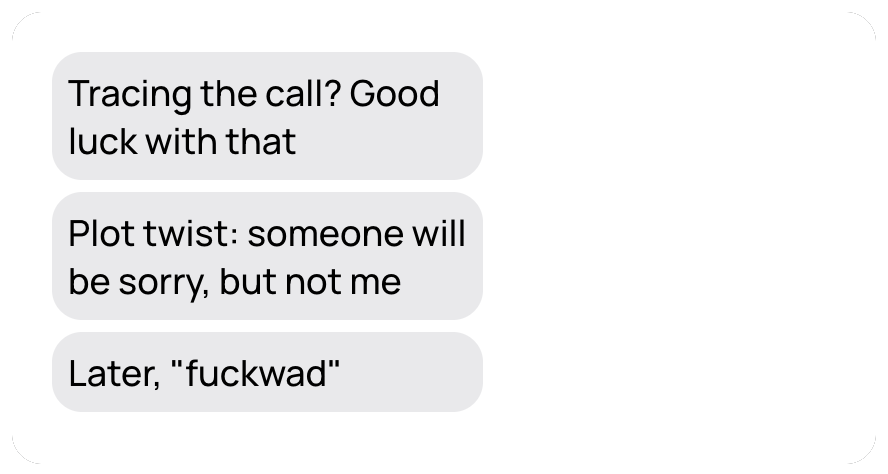
On the drive home Drekkler blasted a heavy metal playlist. He wasn’t much of a music fan, but certain kinds of music got him fired up when it was time to go to war, whether business or personal. And at loud volume, it would drown out the phone’s buzz.
He hadn’t bothered to tell Broyan he was leaving for the day. There was nothing on the calendar. The world didn’t care where Drekkler was.
For now. But he’d make them care. His next film, everything would click. And his comeback would be all the more remarkable.
His huge, beautiful, echoing house. Several women had lived there with him for stretches of time, but not lately. Drekkler wandered through the professionally-decorated rooms, trying to absorb calm from the expensive furnishings. He’d left his phone on the kitchen countertop, powered off. Drekkler almost never turned his phone off-off, but this seemed like a good time to be unreachable.
Somehow it still rang. That stupid marimba default ringtone he never heard because he always had it on silent.
He stepped toward it, wondering what kitchen implement would serve to beat the thing into shattered silence. But when he got close, he saw it wasn’t a 555 number. It was Paul.
Drekkler answered. “Yeah?”
“You were asking about weird calls… 555 calls…”
“Right…?” Drekkler felt a new chill.
“I looked back, I had gotten a couple earlier in the day, I thought they were just spam. But then there was another one, it wouldn’t stop ringing… and when I answered, there was a — oh Christ, they’re calling again —”
Paul was cut off by three beeps. “Call Failed,” the screen reported.
With absurd gentleness, Drekkler placed the phone back on the countertop. It was still turned off, dead black, but a few seconds later a text came in with a cheery ding.
Another new number: 909-555-9999.

The 555 calls had been coming from familiar LA area codes. But 909? Where was that? Oh right… some outlying area he’d never been to… but… Paul had hooked him up with a guy who’d had a 909 number. The guy who’d disposed of that… situation.
Drekkler rummaged through drawers. He didn’t cook, he only ate out or had food delivered, but the kitchen was well equipped. With a house like this, you just had it outfitted with whatever high-end stuff was appropriate. He found a cleaver. German steel, heavy. Fuck the marble countertop.
Just as he swung it up, the screen announced a call from 909-555-9999. But the phone didn’t even ring. Shep’s voice came out of it, slightly distorted by the cold distant anti-noise.
“Don’t bother, Bob. You can’t break it enough to make me stop talking.”
He hesitated, cleaver held high.
“And if you do try, you might have a terrible accident with that cleaver.”
Drekkler set the cleaver down. He was calm, or something that simulated calm. “What do you want? Money?”
“Oh no, not money. I just want to chat. About movies, screenwriting, the business, all that fun stuff.”
Drekkler couldn’t summon a response. After a beat Shep’s voice spoke again.
“Can’t talk right now, Bob. Later tonight. I’ll be in touch.”
As night fell, Drekkler sat by the pool he rarely swam in, the phone on a low table beside him. After a while, despite his reluctance to touch it, he turned the phone on and searched for any news about Paul. Nothing. And even now, the habit was unshakeable: he checked on grosses and reviews for Warlock Junction. No more reviews; it was already becoming yesterday’s news. And the grosses were abysmal. His fans were staying away. Did he even still have fans?
Drekkler ate cold leftover pad thai as he stared into the illuminated blue depths of the pool. For him, fear had always consisted of what if I don’t look like a winner, what if I don’t have enough wealth and fame. Now a new kind of fear hovered. Also, a realization: there was nobody he could turn to for help. He hadn’t spoken to any family in years. He had no friends who were more than very casual and very transactional. Nobody he could imagine trying to tell what was happening. Paul, maybe, but…
Fear hovered a little closer.
But also anger. And defiance. He was Bob Fucking Drekkler, and he would prevail. He’d come up with a plot twist; he always did. That’s how stories worked.
Despite the stress chemicals in his bloodstream, Drekkler dozed, dreaming that he was falling through a thunderously silent, cold, black abyss. He was awoken by the insipid marimba ring.
He didn’t intend to pick up the phone, but he saw his hand reach for it as if he was watching someone else’s hand.
666-555-0000.
“Ready to take a little ride, Bob?”
Drekkler drove. He hadn’t wanted to get into the Range Rover, he’d actively resisted, but it seemed he was no longer fully in control of his own body. He was being sucked along in the insane inevitability of a fever dream. His movie-making mind grudgingly agreed that it made sense. There needed to be a showdown, a climax. And the location was an inspired choice. He had to admit, the kid’s story skills were improving.
In the dark the drive was tricky. It occurred to him that he’d never been here, which was strange. Drekkler parked and carefully made his way down, guided by the phone’s flashlight. His other-directed legs knew where to go. He awkwardly made his way through the fence, ignoring the warning signs, and soon he was approaching.
Ding — a text from 666-555-0000.

Drekkler looked around, searching for anything physical, or in his mind, that could turn the tables. Nothing. All was dark except for the sea of lights twinkling far below.
Was the twist… that he was finally out of plot twists?
“No!” Drekkler screamed, more in rage than fear.
The text dinged.

The irresistible force animated his arms and legs. Holding the phone for light, Drekkler began to climb.
The exact cause of death was undetermined. Drekkler had fallen from the top of the Hollywood sign, fracturing various bones including his skull, before tumbling some forty yards down the slope. So the fall certainly could have killed him, and with his latest professional setback, suicide was plausible. But he’d also suffered a heart attack, and a stroke, and a ruptured aneurysm.
His phone, retrieved from the base of one of the L’s, deepened the mystery. Police investigators found that Drekkler had received several calls and texts that day, including a call at midnight that lasted two hours. Was he being threatened? Blackmailed? Certainly possible for someone with his reputation. Two calls were from his attorney Paul Frosskind, who’d disappeared. But the other calls and the texts baffled investigators as well as Drekkler’s wireless carrier.
The texts were blank. And both the texts and the calls had come from “No Known Number.”
The Hollywood community paid lip service. “We’ve lost a larger-than-life member of the filmmaking family.” “A tragic end to a memorable career.” But in group chats and private conversations, most agreed that not only was his demise something to savor, but it would’ve been nice if he could have suffered more.
Nobody knew how much Drekkler had suffered toward the end. And nobody knew how much he was continuing to suffer, in an extremely cold and dark place far beyond East Nowhere.
Well, one person knew.
Seven months later, a script by an exciting new writer began circulating around town. 555 had it all: a bang-up supernatural story set in a deliciously-observed Hollywood, with a villain clearly modeled on someone they’d all known. It was rare these days for a spec script by an unknown to generate heat, but buzz turned into bidding war, and quirky newcomer Shep Tarrick was suddenly a player.
555 became a hit with both audiences and critics, who praised the directing, the performances, the music, the production design — and the writing. While not quite Oscar bait, the film did win several awards, including for its screenplay.
In his acceptance speeches, Shep was gracious: “I want to pay tribute to the late Bob Drekkler. A real inspiration. He may not have been an easy guy to work with…”
“… but at least he’d take your calls.”
About the Author
Steve Young is a comedy writer, songwriter, and performer who wrote for David Letterman for many years and has also written for The Simpsons. He’s the main subject of the award-winning documentary Bathtubs Over Broadway.
Read more of Steve's Deathbed stories.
Image Credits
- "Bone" line breaks, original art by Becky Munich.